
Gauri Samriddhi Welfare Society names 21 Gold Medalists and Best Research Fellows for 2026, and makes a quiet case for why India needs more people who check whether policies actually work.
GSWS Editorial Team | Jaipur
PHOTO CAPTION: HONOURED: GSWS mentors Yuvraj Singh and Sachin Maitry (top) with the Society’s 2026 Gold Medalists and Best Research Fellows from the Summer and Monsoon Internship Programmes. Photo: GSWS
—- ARTICLE —-
JAIPUR: Picture a small farmer in a Haryana village. On paper, he is exactly the kind of person a national income-support scheme was designed for. He owns a little land, he farms it himself, and he needs the money. Yet the instalment never arrives. Somewhere between his patwari’s register and a government database, a name is spelt differently, a record is not updated, and he quietly drops out of the system.
This year, a GSWS intern went looking. His paper on why eligible farmers in Haryana fall out of PM-KISAN is one of more than a dozen studies that have earned young researchers a place on the honour list of Gauri Samriddhi Welfare Society (GSWS), which has named 21 Gold Medalists and Best Research Fellows from its Summer and Monsoon Internship Programmes 2026.
The honours celebrate young talent. They are also a statement about what research is for.
Why bother with research at all?
At its simplest, research is the habit of not taking things on faith. It means asking, “How do we know this is true?” and then doing the slow work of finding out.
That habit matters most in public policy. Schemes arrive with targets, budgets and glossy brochures, but rarely with an honest, independent answer to a plain question: did the scheme reach the people it was meant for, and did it change their lives?
This is the gap between the file and the field. On file, a scheme can look complete. In the field, it may be stuck at a bank counter or lost in a land record. Research makes that gap visible, so it can be measured and fixed.
Where India stands on research
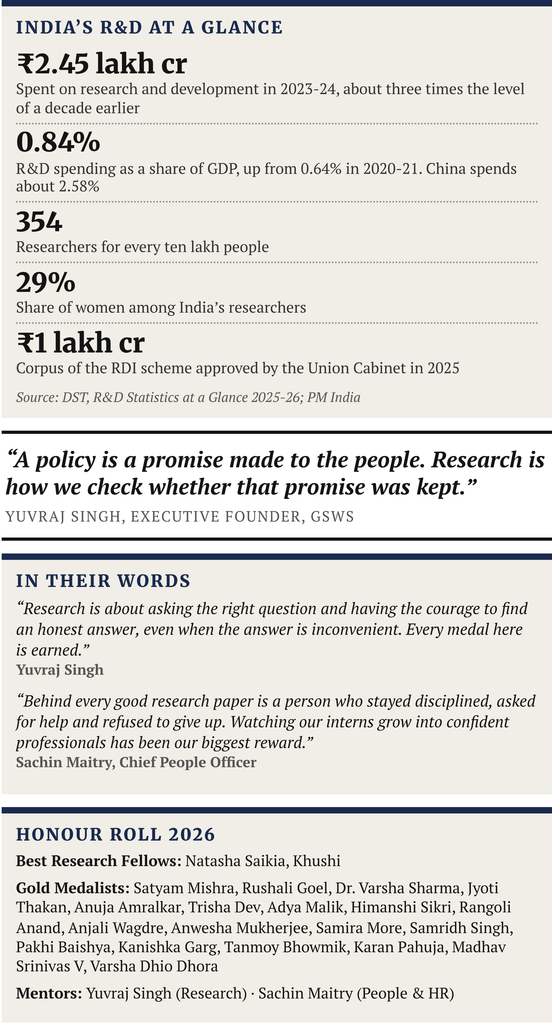
The good news first. According to the Department of Science and Technology, India’s research spending has roughly tripled in a decade (see box). Now the harder truth: China spends about 2.58 per cent of its GDP on R&D, roughly three times India’s share, and some experts have asked for more transparency on how the latest figures were measured.
There is a second, quieter gap. Far less goes into studying how public policies perform on the ground. Who checks whether a girls’ education scheme kept girls in school, or whether a harassment law is used at all? It is exactly this gap that GSWS has chosen to work in.
The GSWS idea: read the policy, then go and check it
Founded in 2025 with the motto “Research to Solution” and the guiding value of Humanity, GSWS trains young Indians to critically analyse public policy: to compare the decorated version of a scheme found in budget speeches and reports with the ground reality in the village, the classroom and the household, and to show exactly where the chain breaks.
Every intern must pick a real problem, review what is known, collect evidence and write a formal research paper. There are no shortcuts.
The writer who teaches researchers
At the centre of this effort is Mr. Yuvraj Singh, Executive Founder, Research Associate and Mentor at GSWS, known to readers by his pen name “Priy Yuvraj”, under which he has written several books. A writer knows an idea is worth little until it is put into clear words; a researcher knows clear words are worth little without evidence. Mr. Singh insists on both.
He has trained hundreds of students in research, starting them with a question rather than a topic, and then asking the one thing every young researcher dreads: “But how do you know?” Several 2026 interns saw their papers published in the research journal IJIERM, for most of them a first.
The man who looks after the people
If Mr. Singh shapes the research, Mr. Sachin Maitry shapes the researchers. As Mentor and Chief People Officer, he leads the Society’s Human Resource Division, which handles intern selection, onboarding, team coordination, discipline and the personal growth of every participant.
Interns are spread across many states and juggle exams, jobs and family duties. Regular check-ins and timely encouragement from his division kept them on track.
What the young researchers found
Karan Pahuja wrote the study behind the story at the top of this page. He examined why eligible farmers in Haryana are excluded from PM-KISAN, and traced much of the problem to land-record verification. His work is a textbook case of the file-and-field gap: a scheme that works on paper can still stall at the patwari’s desk.
For millions of students, few things are as painful as hearing that an exam they prepared for months has been cancelled because the paper leaked. Anuja Amralkar and Trisha Dev took up that frustration as a research question. Their co-authored study looks at where India’s legal and administrative safeguards fail and how stronger anti-paper-leak laws could protect honest candidates.
Samira More looked past the number of women in panchayats at proxy politics, where a male relative quietly runs the office, and at elite capture. Representation, she argues, is not the same as empowerment.
Beyond India’s borders, Madhav Srinivas V and Varsha Dhio Dhora jointly assessed how well SAARC and BIMSTEC have served South Asia. Their analysis explores why regional cooperation has so often stalled, and what it might take to revive it among neighbours bound by trade, rivers and history.
And Samridh Singh went back many centuries. His paper reconstructs how ancient sailors read the monsoon winds to cross the western Indian Ocean, a reminder that Indian knowledge of climate and the sea once powered trade across continents.
Women’s work, young minds and everyday health
Anjali Wagdre asked whether India’s POSH law against workplace sexual harassment has turned into real gender justice, or exists only on paper. Rangoli Anand studied the unpaid work women put into small family businesses, an “invisible co-worker” missing from wages and official data.
Several medalists turned their attention to the lives of young Indians. Dr. Varsha Sharma, a dentist and former research scholar, studied how screen use at bedtime affects the sleep of college students, a concern in almost every home with a smartphone. Adya Malik explored how the fear of missing out, or FOMO, shapes the choices of university students. Anwesha Mukherjee measured career uncertainty among young adults in Dankuni, in West Bengal’s Hooghly district, putting numbers to an anxiety that many graduates feel but seldom talk about. Tanmoy Bhowmik studied digital skills among young adults in Kolkata’s suburbs and found that being online is not the same as being equally capable online. And Jyoti Thakan, a microbiology researcher, surveyed how tenants and paying-guest residents in Chandigarh store their drinking water, exposing a quiet hygiene risk in fast-growing cities.
The Society also honoured Himanshi Sikri, Kanishka Garg, Satyam Mishra, Rushali Goel and Pakhi Baishya as Gold Medalists for their dedication and research contributions during the programme.
Asking what AI is doing to us
The title of Best Research Fellow 2026 has gone to Natasha Saikia and Khushi, who are measuring how artificial intelligence is changing the way people learn, think, work and relate to one another. AI has moved quickly into classrooms, offices and family phones, yet careful evidence on its social effects is still scarce.
As with any new policy or technology, AI’s decorated promise and its ground reality may not always match, and someone needs to check.
A small medal, a larger message
Every farmer who falls out of a scheme, every student hit by a leaked paper and every woman whose elected office is run by someone else becomes visible only when somebody asks the right question. GSWS has made that question its mission, and its 2026 cohort shows that the road from research to solution can begin with a curious young mind, a demanding mentor and a team that cares.
About GSWS: Gauri Samriddhi Welfare Society is a Rajasthan-based non-profit founded in 2025. Guided by its motto “Research to Solution” and its core value of humanity, it runs research internships, mentorship programmes and social welfare initiatives. @gswsresearchorg on all platforms | www.gswsresearch.org
HONOUR ROLL 2026
Best Research Fellows: Natasha Saikia, Khushi
Gold Medalists: Satyam Mishra, Rushali Goel, Dr. Varsha Sharma, Jyoti Thakan, Anuja Amralkar, Trisha Dev, Adya Malik, Himanshi